
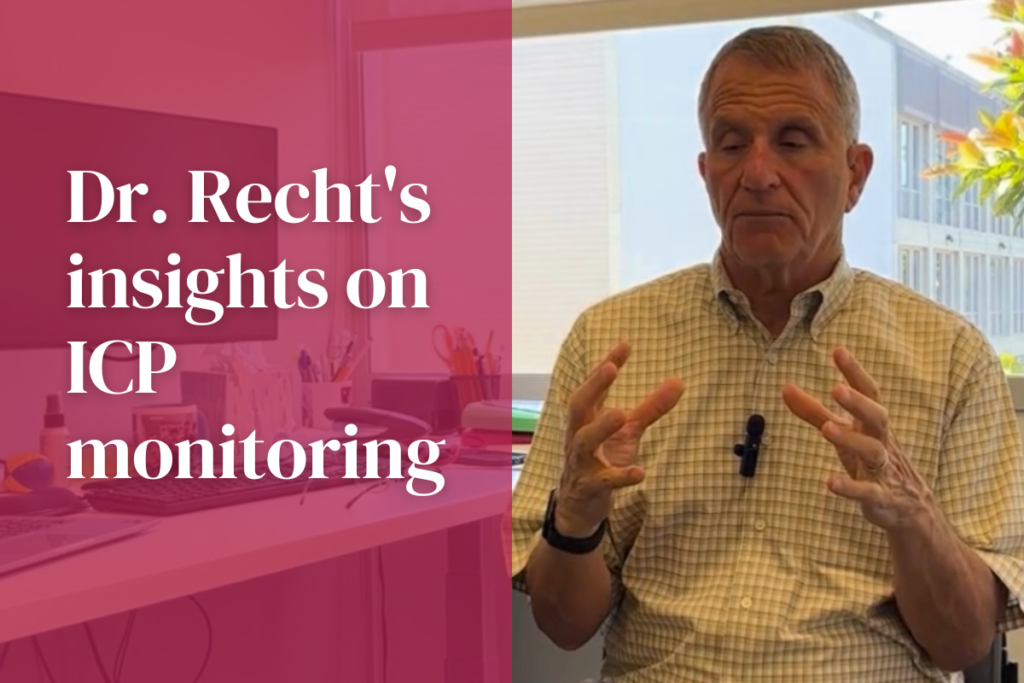
We are delighted to share Dr. Lawrence Recht's insights on intracranial pressure (ICP) monitoring and related issues. Dr. Recht serves as a Professor of Neurology at Stanford University, where he has been contributing to the field for over 20 years. He holds the position of Chief of Adult Neuro-Oncology at Stanford, and chairs the Stanford Cancer Center Scientific Review Committee.
In this Q&A interview, he shares his perspective on his work, the importance of spinal fluid, ICP monitoring, and emerging techniques and their applications in the diagnosis and treatment of neurological disorders.
Could you please introduce yourself?
I'm a neuro-oncologist who works in the clinic and in the laboratory. I've been at Stanford for 20 years and I run the adult neuro-oncology division.
Why is intracranial pressure monitoring important?
The spinal fluid bathes the brain. It is important in brain circulation — delivering nutrients to the brain and taking waste products away. It is also an important cushion. The brain lives in a very closed box, and the brain itself does not like to be shaken, so the CSF provides much of the cushioning the brain needs to work effectively.
What are the common conditions that require ICP monitoring?
Because the brain is in a very tight box, when things grow inside the brain, spinal fluid circulation is impaired. That creates a need for the spinal fluid to compensate, and that raises the pressure. CSF pressure is therefore a window into the skull's capacity to handle the brain. Both sides of that equation are finely balanced: too much mass and too little mass create problems of high and low pressure respectively, and both are commonly encountered clinically.
In which diseases is ICP an indicator?
Masses raise intracranial pressure — tumors and infections, located either within the substance of the brain or on its surface. All of these can change spinal fluid pressure and cause symptoms that can be dramatic, and potentially lethal at their most extreme. But beyond masses, spinal fluid circulation itself changes over the course of life and in response to many things, and that alone can cause headaches without any mass effect at all.
That is probably the most common situation in which pressure monitoring could be very helpful, especially in a chronic stage, because these patients are always symptomatic. It would be valuable for the practitioner to understand under what conditions pressure is being affected when planning how to relieve symptoms.
How is ICP monitoring done currently?
To monitor spinal fluid pressure accurately today, you have to put some kind of tube into the spinal fluid compartment — either in the back or through the skull — and link it to a way of measuring pressure. There are non-invasive approaches, but they are not accurate enough to replace direct measurement.
Where is the field heading?
What is missing is the ability to follow pressure over time, outside the hospital, in the patient's own life. Long-term measurement would let clinicians relate pressure to symptoms and to treatment, rather than capturing a single number in a single moment.
← All insights